
Shiawassee Projected Versus Actual Release
A projected date is an estimate or legal milestone before departure. An actual release date records an event that already occurred. For an MDOC prisoner, Earliest Release Date marks the point when the Michigan Parole Board may gain jurisdiction. It does not mean the prisoner will walk out that day. Date Paroled records the later transition from prison into parole, while Maximum Discharge Date is the outside sentence endpoint when earlier parole does not occur, subject to the sentence rules.
County jail terminology differs. Shiawassee County does not publish a projected-date calculator or online jail record. The jail register may contain the release date under the sentence, including an eligible good-time computation, but the actual door-out time appears in the release record. A person awaiting trial has no sentence endpoint to calculate. Bond, dismissal, remand, a new court order, or a hold from another agency can control what happens next.
Find a Shiawassee Release Date
Start with the custody system, not just a name. The Shiawassee County Jail, MDOC, and the courts hold different pieces of the timeline. OTIS does not cover jail-only sentences or people held before sentence. Conversely, the Sheriff cannot calculate a state prisoner's parole eligibility. The legal order may explain a date, but it may not show the precise time the person left a facility.
- Call the Shiawassee County Jail at 989-743-2230 to learn whether the person remains there.
- For a county sentence, obtain the judgment or commitment from the 66th District Court or 35th Circuit Court.
- Ask the Sheriff for the recorded sentence calculation and, after departure, the release or transfer form.
- For a state prisoner, search Michigan OTIS by six-digit MDOC number or name.
- Read every sentence line and distinguish Earliest Release, Date Paroled, and Maximum Discharge.
- After the expected event, confirm current status with the facility, OTIS, or a release notification rather than relying on the estimate alone.
The Shiawassee County release-record paths explain how the court order, jail form, and state record fit together for a named person.
Shiawassee Release Dates in OTIS
OTIS covers MDOC prisoners, parolees, qualifying probationers, and people publicly displayed for a limited period after discharge. Search by MDOC number when possible. A name search can be narrowed by first name, sex, race, age, offender status, and marks, scars, or tattoos. Compare the photograph and identity facts, then inspect each sentence. One discharged count does not prove that no other sentence remains active.
| OTIS field | What it means | What it does not prove |
|---|---|---|
| Earliest Release Date | Earliest point of Parole Board jurisdiction or eligibility | A fixed departure date |
| Date Paroled | Actual transition from prison or camp into parole status | The end of all supervision |
| Maximum Discharge Date | Outside sentence endpoint under the applicable rules | That the person will remain imprisoned until that date |
| Current status | Prisoner, Parolee, Probationer, Discharged, or an absconder category | The complete history of every county-jail stay |
The OTIS search form and record fields display these distinctions.
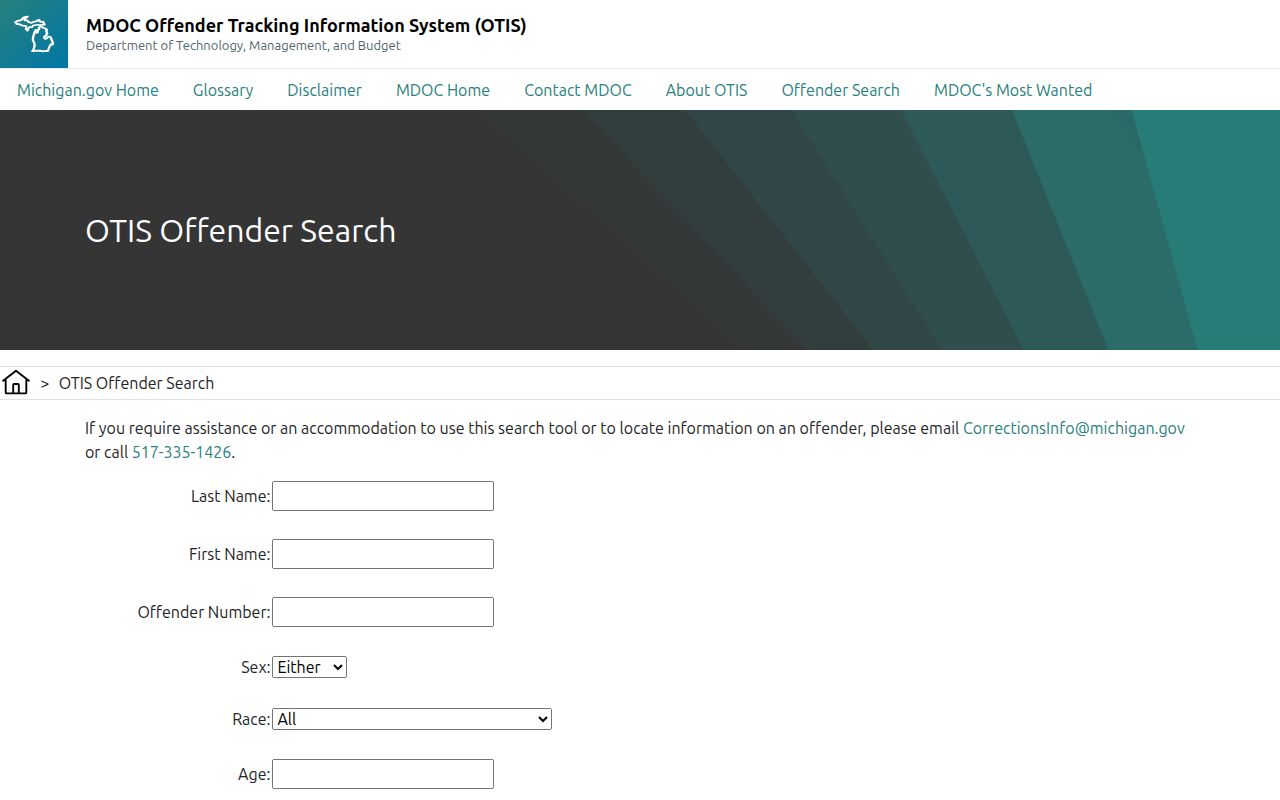
The screenshot shows why the full record matters: status filters and separate date labels prevent an eligibility date from being mistaken for an actual Shiawassee County release.
Note: OTIS excludes county-jail-only cases and older discharged records outside its public display period, so a blank search is not final proof.
Michigan Prison Release Date Computation
Michigan generally uses indeterminate sentencing. The judge sets a minimum term, and statute supplies the maximum. MDOC computes the date fields from the Judgment of Sentence. Jail credit, amended judgments, consecutive sentences, offense-specific credit rules, misconduct, and Parole Board action can affect the displayed timeline. “Consecutive” means one sentence runs after another rather than at the same time.
Board jurisdiction is governed by MCL 791.234. The public-safety prerequisite appears in MCL 791.233, and MCL 791.235 governs procedure and confirms that parole is not guaranteed. Even after a favorable decision, the Parole Release Unit must finish placement and notice work. New misconduct or other adverse facts can suspend the grant before physical departure.
- Indeterminate sentence
- A sentence with a judicial minimum and a statutory maximum.
- Parole eligibility
- The point when the Board may consider release, not a right to release.
- Jail credit
- Qualifying time already served that the judgment applies to a sentence.
- Detainer
- A request or hold from another authority that may change the next custody destination.
Shiawassee Truth-in-Sentencing Release Rules
Michigan does not use a broad 85% formula. Covered truth-in-sentencing prisoners must serve 100% of the judicial minimum in prison before parole consideration. The rule applies to specified assaultive offenses committed on or after December 15, 1998, and to all other covered crimes committed on or after December 15, 2000. Those prisoners cannot shorten the minimum through good time, disciplinary credits, or education credits.
Older offenses may remain under legacy credit systems depending on the offense date and type. MCL 800.34 addresses disciplinary time. MDOC explains that disciplinary time is not simply tacked onto the minimum, although the Board considers it. This makes an offense date and sentence line essential before anyone tries to interpret the Earliest Release Date.
The MDOC truth-in-sentencing explanation states the 100%-of-minimum rule and its date boundaries.
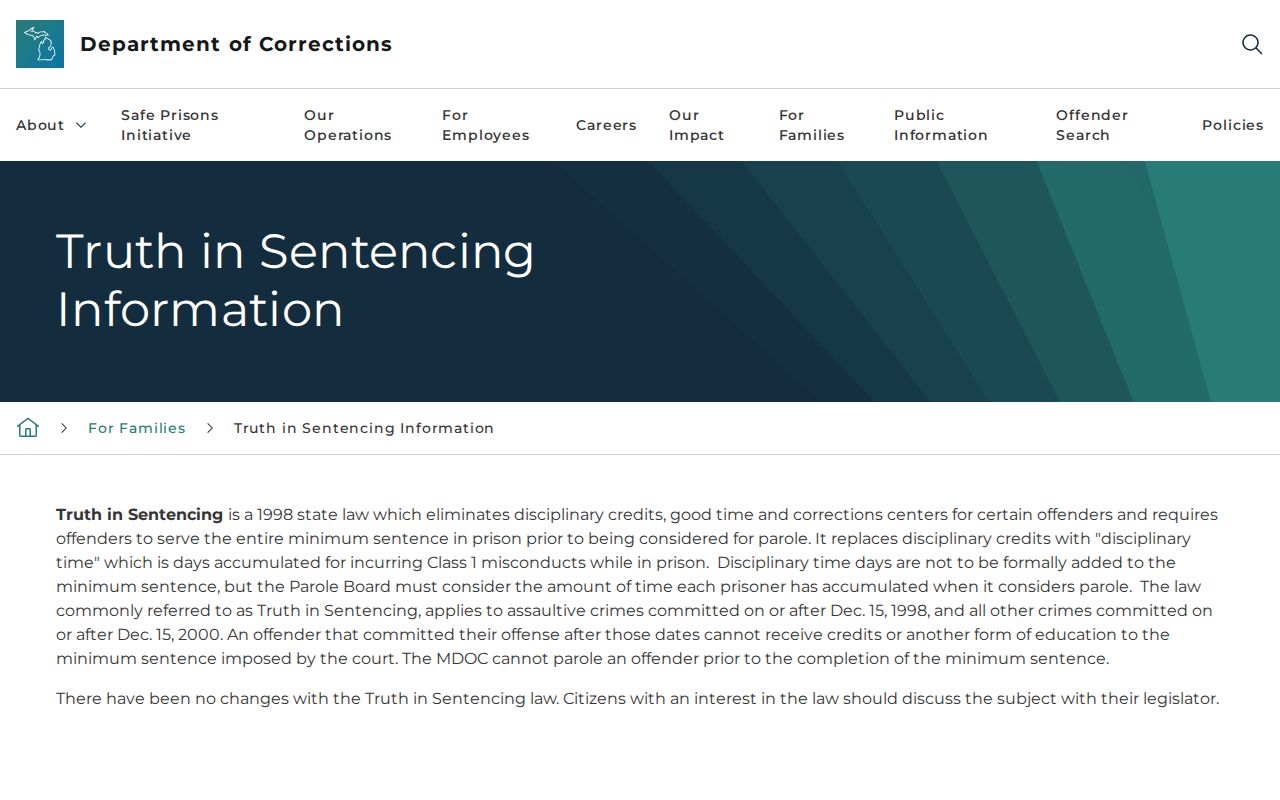
The source directly refutes a generic percentage estimate and supports reading the actual OTIS fields for the specific Michigan sentence.
Shiawassee Jail Release Date Calculation
County-jail sentences are calculated outside OTIS. MCL 801.56 requires certain jail-register information, including the release date under the sentence with good-time computations. The working date can also depend on the commitment, jail credit, multiple cases, another agency's hold, and any lawful forfeiture or restoration of credits.
The Sheriff has not published a Shiawassee calculator or a weekend and holiday release policy. Do not apply the prison Earliest Release Date to a county sentence, assume a standard percentage, or move a date to a weekday without a source. Obtain the judgment from the court and ask the jail for its recorded calculation. After release or transfer, request the form that states the actual time, legal basis, and destination.
A pretrial detainee follows a different path. Bond may allow release, but the amount and conditions come from the court. Dismissal or a personal-recognizance order may also lead to departure. Yet another warrant or detainer may keep the person in custody or send the person to another agency. No sentence-based date exists until there is a sentence to compute.
Note: Shiawassee County publishes no weekend-release rule, so only the Sheriff and the court record can resolve that timing question.
What Changes Shiawassee Release Dates
A date can change because the source document changes, a new custody barrier appears, or a discretionary parole step remains unfinished. Compare each update with the same MDOC number or booking identity. Keep the access date as well. That record trail makes it possible to explain why an earlier estimate differs from the later outcome.
| Factor | Possible effect | Best confirmation |
|---|---|---|
| Amended judgment or jail credit | Recomputes the sentence timeline | Sentencing court and corrected MDOC or jail record |
| Consecutive sentence | Moves an endpoint because terms run in sequence | Every judgment and every OTIS sentence line |
| Misconduct or credit rule | Affects Board review or an eligible legacy calculation | MDOC record and applicable statute |
| Parole grant or denial | Moves the case toward release or keeps custody in place | Board document, then Date Paroled |
| Detainer, warrant, or other hold | Prevents community release or changes destination | Facility release or transfer record |
| New court order | Changes bond, custody, sentence, or release authority | Register of Actions and signed order |
A transfer can also look like a release when only one agency's record is viewed. Shiawassee County Jail may release a person to MDOC after a prison sentence, deliver the person to another county, or act on another authority's hold. In that event, the Shiawassee County custody episode ends while confinement continues elsewhere. The Sheriff transfer record identifies the destination, and OTIS should be checked only when MDOC jurisdiction followed.
Conflicting dates should be ranked by what each source can prove. A signed judgment controls the sentence terms. MDOC calculates state dates from that judgment. The jail maintains its county sentence and departure records. A VINE alert reports an agency event, while a court docket explains the legal action. When two dates differ, do not average them or choose the later one without explanation. Obtain the corrected source record and keep the earlier version with its access date.
Confirm a Shiawassee Release Date
Before the expected event, label an ERD as parole eligibility and a jail calculation as subject to the court record and other holds. Afterward, look for Date Paroled and current Parolee status for a state-prison release. For a county-jail matter, call 989-743-2230 and obtain the release or transfer form. A court disposition may explain the legal authority, but it may not capture the exact time the person crossed the facility door.
Michigan VINE can send a person-specific release or transfer alert, but it is a notification service rather than a certified release instrument. The Shiawassee County VINE inmate check explains how to identify the reporting agency and read release and transfer as separate events. A federal prisoner requires the BOP locator, while an immigration transfer calls for the ICE locator. Neither system should be blended into a Shiawassee County Jail date.
For the most reliable timeline, preserve the projected field, the later status update, and the final release document as separate records. Each answers a different question: when release could occur, what status followed, and when the physical departure or transfer took place.