
No Shiawassee 72-Hour List
The official Shiawassee County Jail page is a service and contact page. It does not contain a 72-hour release list, a live roster, release filters, booking details, or a release-photo archive. No official rolling-window definition, field set, refresh rate, or web retention period exists to interpret. The only published inmate lookup direction is to call the jail.
A three-day result therefore must be assembled for a named person or requested as existing records within exact dates. Do not rename the Sheriff's jail page as a feed. It answers where to call, not who left. Also avoid unofficial roster-like sites. They can be stale, may blend current and old bookings, and do not prove whether Shiawassee County released or transferred anyone during the chosen period.
Check Shiawassee Three-Day Releases
Begin with a firm interval. Write the start and end date and time before contacting the Sheriff. A rolling 72-hour span counted backward from the current time differs from three named calendar dates. The research found no local published rule that defines such a window, so the requester must state it clearly.
- Open the official jail page and use its inmate-information number for a named person.
- Ask whether the person remains at the Shiawassee County Jail or departed during the stated interval.
- Clarify whether the event was community release, transfer, or another form of custody change.
- Check Michigan VINE for the reporting agency, event, and timestamp.
- Check the District or Circuit Court record for bond, dismissal, sentence, or another legal basis.
- Request the Sheriff's release or transfer record for durable proof.
Each step adds a different fact. The phone gives present status. VINE can show an event from a participating agency. The court supplies legal authority. The release or transfer form links the booking to the facility's movement. If the facts indicate an MDOC transfer, use OTIS to follow the state-custody handoff.
Note: A three-day search is a date range, not proof that a person returned to the community during that span.
Shiawassee 72-Hour Record Fields
No public feed means there are no online Shiawassee County 72-hour fields to report. A focused request can still seek existing records that reflect releases within the interval. Ask for electronic delivery and a cost estimate before charges exceed a limit that you set. Michigan FOIA does not require an agency to create a new summary or compilation that it does not maintain.
| Field or record | Why it matters |
|---|---|
| Name and booking identifier | Connects the event to the correct person and jail stay. |
| Booking date and time | Separates the relevant custody episode from an earlier booking. |
| Release date and time | Places the event inside or outside the defined 72-hour range. |
| Release reason | Identifies bond, time served, dismissal, or other authority. |
| Transfer agency or destination | Shows when custody moved instead of ending. |
| Court or bond document | Explains the legal basis for the movement. |
The state's General Schedule 11 says a jail inmate jacket may include booking cards, bonds, release forms, transfer papers, court documents, and property release forms. The schedule retains that category until release plus ten years. This is a retention rule, not a guarantee that each Shiawassee file contains every item and not evidence of any web archive.
Shiawassee Weekend Release Checks
A 72-hour interval is most useful when the suspected event spans several dates. It may cover a weekend in one request and reduce the chance of choosing the wrong calendar day. Still, the research found no official Shiawassee County statement that processing follows a special weekend or holiday schedule. Do not invent one or assume an approved order produced instant physical release.
A bond order can exist while staff complete processing or resolve another hold. A court entry may post before or after the jail's movement entry. A phone statement gives current custody but may not preserve the prior event. When time matters, compare source timestamps and request the release form. The form is the strongest local record of when the facility relinquished custody, while the order explains why it could do so.
A useful chronology keeps each event separate: the court authorizes release, required terms are met, jail staff process the movement, and the receiving system posts its own status. Those actions need not share one timestamp. If a person was ordered released late in the interval but another agency hold remained, the physical departure may occur later or may become a transfer. The 72-hour question should therefore ask both when Shiawassee stopped holding the person and what custody, conditions, or supervision followed.
| Source | Question answered |
|---|---|
| Jail phone | Is the person held here now? |
| Release or transfer form | When and how did the jail relinquish custody? |
| Court record | What bond, judgment, or order authorized the result? |
| VINE | What event did the reporting agency send? |
| OTIS | Did MDOC jurisdiction follow? |
Request Shiawassee Three-Day Records
The Sheriff FOIA page supplies request forms and policy material. A period request should name the beginning and ending timestamps and ask for existing records sufficient to reflect releases or transfers. If the office does not maintain a period report, it need not construct one. A named-person request for the release form and booking linkage may then be the sounder route.
Give a full legal name, known aliases, birth date if known, and a booking or case number when available. Ask for the release date and time, legal basis, destination, transfer paperwork, and related bond or court documents. Request redaction of exempt content instead of wholesale denial where feasible. Keep the response letter because it defines what the office searched and produced.
When seeking everyone released during the range, phrase the request around an existing log, report, or set of records. Do not demand that staff calculate a new 72-hour list. If no period record exists, narrow the request to the named person and booking. A request for “records sufficient to show release or transfer” targets the core proof without assuming that the Sheriff uses the same field names as another county.
Use the 66th District Court record for misdemeanors and felony preliminary steps. A felony that moved forward may also require the 35th Circuit Court record. Court entries can identify bond, disposition, judgment, sentence, probation, or discharge, but they may not preserve the jail's exact physical departure time.
Shiawassee Release Archive Gap
The lack of a web list is not the lack of a government record. The Michigan retention schedule recognizes a potential inmate jacket for ten years after release. It also covers aggregate monthly criminal-justice summaries and midnight counts for shorter periods. Those aggregate records can support a statistics request, but they do not identify a person.
The official page shows the public-facing limitation. The Shiawassee jail source directs inmate questions to a phone rather than a 72-hour archive.
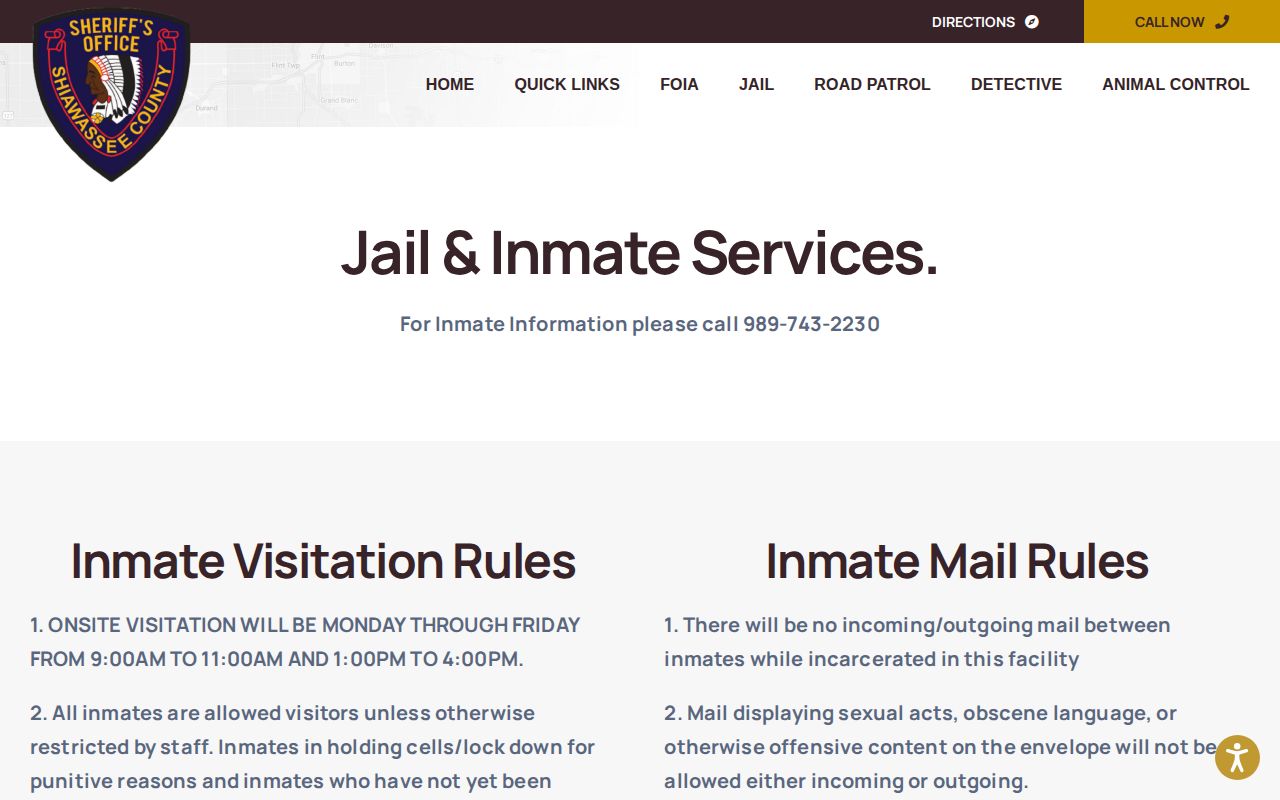
That source supports a person-specific status check. It does not establish the fields, cadence, or content of a release list that the Sheriff does not publish.
Note: State retention schedules describe records an agency may keep; they do not create an online Shiawassee County release feed.
Interpret Shiawassee Release Results
“Released by Shiawassee County” can mean return to the community after bond, personal recognizance, time served, dismissal, or another court order. It may also describe a transfer to MDOC, another county, federal authorities, or immigration custody. The Sheriff's stated duties include court and prison transport and extradition. A departure must therefore be paired with a destination.
Michigan VINE may report release, transfer, or escape as distinct events. Read the agency and event together. OTIS is appropriate only when MDOC jurisdiction exists; it excludes jail-only people. A Parolee status indicates release from state prison into supervision, while Prisoner indicates continued state custody. For a suspected federal or immigration handoff, use the BOP or ICE system required by the facts.
An older Shiawassee release may also disappear from a live public system without erasing the event. VINE is event-oriented, MiCOURT display can vary by court and case, and OTIS removes a discharged public record after its limited display period. The retained Sheriff record and court copies are better archival paths. A blank web result calls for better identifiers and a focused request, not a claim that the person was never booked or released.
Choose a Shiawassee Release Window
The wider range is useful when the exact day is uncertain. It does not make the unavailable feed appear. For a likely same-day event, the Shiawassee County 24-hour release route narrows the inquiry. For a known person and a future event, VINE registration may be more useful because it can send a custody-change notice.
For a past three-day interval, a bounded record request is the durable option. For one named person whose custody path is not known, use the Shiawassee County released-inmate search path to compare jail, court, VINE, MDOC, federal, and immigration sources. Do not treat one blank result as proof that no release occurred.